How to Change Notepad Encoding to UTF-8 by Default in Windows 11
If you regularly work with code, multilingual text, CSV files, websites, or configuration files, using the wrong text encoding can create serious formatting problems. Characters may appear broken, symbols can become unreadable, and some applications may fail to process the file correctly.
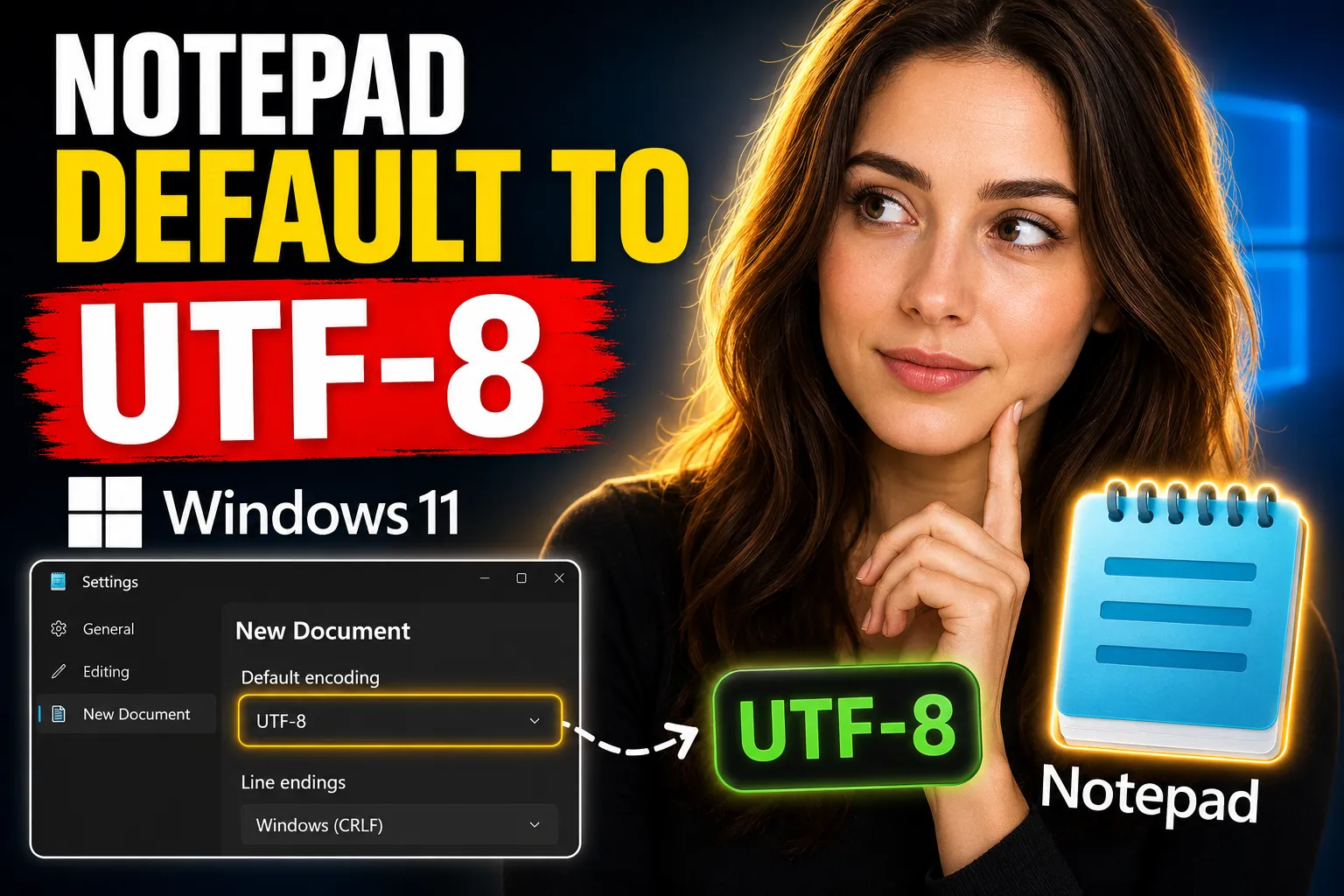
In Windows 11, Notepad now supports UTF-8 much better than older versions of Windows, but many users still want to ensure UTF-8 is consistently used as the default encoding when creating or saving files.
This guide explains how to change Notepad encoding to UTF-8 by default in Windows 11, why UTF-8 matters, and what to do if Windows still saves files with the wrong encoding.
Table of Contents
- What UTF-8 Encoding Means
- Why UTF-8 Is the Recommended Standard
- Does Windows 11 Notepad Use UTF-8 by Default?
- How to Save Files as UTF-8 in Notepad
- How to Make UTF-8 the Default System Encoding in Windows 11
- How to Verify a File Is Saved in UTF-8
- Common UTF-8 Problems and Fixes
- Best Free Online Notepad Alternatives
- When UTF-8 May Not Be the Right Choice
- FAQ
- Conclusion
What UTF-8 Encoding Means
UTF-8 is a universal text encoding standard used to store and display characters from almost every language.
It supports:
- English text
- Accented characters
- Asian languages
- Arabic and Hebrew
- Emojis
- Programming symbols
Without UTF-8, text files can display corrupted characters like:
é
’
???
This usually happens when a file is opened using the wrong encoding.
Simple Explanation
Character encoding tells your computer how to convert text into data.
UTF-8 is popular because:
- It works across platforms
- It supports multiple languages
- It is compatible with modern software
- It avoids most character corruption issues
Today, UTF-8 is the default standard for:
- Websites
- HTML
- JSON
- XML
- Python
- JavaScript
- APIs
- Linux systems
- Cloud platforms
Why UTF-8 Is the Recommended Standard
Most modern applications expect UTF-8 encoding.
Using older encodings like ANSI or Windows-1252 can cause compatibility issues when sharing files between:
- Windows
- macOS
- Linux
- Web servers
- Databases
- Development tools
Benefits of UTF-8
| Benefit | Why It Matters |
|---|---|
| Universal compatibility | Works on almost all modern systems |
| Multi-language support | Supports global text correctly |
| Better web compatibility | Standard encoding for websites |
| Programming support | Required by many coding environments |
| Reduced corruption issues | Prevents broken special characters |
If you edit configuration files, code snippets, Markdown files, or multilingual documents, UTF-8 should usually be your default choice.
Does Windows 11 Notepad Use UTF-8 by Default?
Yes — in most modern Windows 11 installations, Notepad already defaults to UTF-8.
Microsoft updated Notepad in recent Windows versions to improve Unicode and UTF-8 handling.
However, there are exceptions:
- Older upgraded systems may retain legacy encoding behavior
- Some files inherit previous encodings
- Third-party software may override encoding settings
- Regional language settings can affect compatibility
- Certain enterprise environments disable UTF-8 globally
So while UTF-8 is often the default today, it is still useful to verify your settings.
How to Save Files as UTF-8 in Notepad
The easiest method is manually selecting UTF-8 when saving a file.
Step-by-Step Instructions
- Open Notepad
- Type or paste your content
- Click File → Save As
- In the Save window, locate the Encoding dropdown
- Select UTF-8
- Save the file
[IMAGE ALT: Windows 11 Notepad Save As dialog showing UTF-8 encoding selection]
This guarantees the file uses UTF-8 encoding regardless of system defaults.
How to Make UTF-8 the Default System Encoding in Windows 11
Windows 11 includes a system-wide UTF-8 option that improves compatibility across applications.
Important Note
This changes Windows language behavior globally.
Most users will benefit from it, but older software may break if it expects legacy encodings.
Steps to Enable UTF-8 System Locale
- Press Windows + S
- Search for Control Panel
- Open Region
- Go to the Administrative tab
- Click Change system locale
- Enable:
Beta: Use Unicode UTF-8 for worldwide language support- Click OK
- Restart your PC
After rebooting, Windows uses UTF-8 more consistently across compatible applications.
What This UTF-8 Setting Actually Changes
Many guides skip this part, but it matters.
The UTF-8 system locale affects:
| Area | Impact |
|---|---|
| Legacy desktop apps | Better Unicode handling |
| Console applications | Improved multilingual text |
| File parsing | More consistent character handling |
| Older APIs | Unicode compatibility improvements |
What It Does NOT Change
It does not automatically:
- Convert old files to UTF-8
- Force every application to save UTF-8
- Fix broken text from already corrupted files
- Override app-specific encoding settings
This is an important distinction.
How to Verify a File Is Saved in UTF-8
Sometimes files appear correct even when they are not actually UTF-8 encoded.
Here are reliable ways to verify encoding.
Method 1: Reopen in Notepad
- Save the file
- Close Notepad
- Reopen the file
- Check for corrupted characters
This is basic but not always reliable.
Method 2: Use VS Code
Visual Studio Code shows file encoding in the status bar.
Open the file and check the bottom-right corner.
You should see:
UTF-8If not:
- Click the encoding label
- Select:
- Save with Encoding
- UTF-8
Method 3: Use PowerShell
You can inspect encoding using PowerShell commands.
Get-Content yourfile.txtOr use advanced detection tools for precise verification.
This method is more useful for developers and system administrators.
Common UTF-8 Problems and Fixes
Even after enabling UTF-8, some issues may continue.
Problem 1: Strange Characters Still Appear
Example:
ñ
“
Cause
The file was originally saved with another encoding.
Fix
Open the file using the correct original encoding first, then resave as UTF-8.
Problem 2: CSV Files Break in Excel
Microsoft Excel sometimes mishandles UTF-8 CSV files.
Fix
Use:
CSV UTF-8 (Comma delimited)when exporting data.
Problem 3: Older Applications Stop Working
Some legacy software expects ANSI encoding.
Fix
Disable the UTF-8 beta system locale if compatibility issues appear.
Problem 4: Web Pages Display Incorrect Symbols
This usually happens when the HTML file lacks a charset declaration.
Fix
Add:
<meta charset="UTF-8">inside the <head> section.
Why Developers Prefer UTF-8
UTF-8 has become the standard across modern development environments.
Common Platforms Using UTF-8
| Platform | UTF-8 Usage |
|---|---|
| HTML5 | Default web encoding |
| Linux | Standard text encoding |
| GitHub | UTF-8 preferred |
| JSON APIs | UTF-8 standard |
| Python 3 | UTF-8 commonly used |
| Node.js | UTF-8 default in many cases |
Without UTF-8 consistency, developers often encounter:
- Broken APIs
- Database import failures
- Encoding mismatch errors
- Invalid JSON parsing
- Corrupted logs
Best Free Online Notepad Alternatives
Sometimes you may not want to rely entirely on desktop Notepad, especially when collaborating, taking quick notes, or accessing files across devices.
Write Notes
Write Notes is an online note-taking application and online notepad that works directly in your browser.
It is useful for:
- Quick text editing
- Drafting notes
- Temporary code snippets
- Cross-device access
- Simple plain-text writing
Unlike traditional desktop editors, browser-based tools can be more convenient when switching between devices or sharing content quickly.
Free Online Notepad
Free Online Notepad provides a lightweight browser-based editor for creating and saving notes without installing software.
This can be useful if:
- You use public computers
- You work remotely
- You need quick temporary editing
- You want distraction-free writing
Online Whiteboard Collaboration Tools
Text editing is not always enough when brainstorming workflows, planning projects, or explaining technical concepts.
Online Collaborative Whiteboard
Online Collaborative Whiteboard allows teams and individuals to sketch ideas, collaborate visually, and organize concepts in real time.
This is especially useful for:
- Remote collaboration
- Team planning
- Educational sessions
- Technical architecture diagrams
- Brainstorming sessions
For developers and technical teams, combining UTF-8-compatible text tools with collaborative whiteboards can improve documentation workflows significantly.
When UTF-8 May Not Be the Right Choice
UTF-8 is usually the best option, but there are exceptions.
Legacy Enterprise Software
Some older systems still rely on:
- ANSI
- Shift-JIS
- ISO-8859
- Windows-1252
Changing encoding can break compatibility with:
- Old databases
- Industrial software
- Legacy accounting systems
- Specialized hardware tools
Fixed-Encoding Import Systems
Some import/export systems require exact encodings.
Examples include:
- Banking systems
- ERP platforms
- Government submission portals
Always check system requirements before converting critical files to UTF-8.
UTF-8 vs ANSI Comparison
| Feature | UTF-8 | ANSI |
|---|---|---|
| Multi-language support | Excellent | Limited |
| Emoji support | Yes | No |
| Web compatibility | Excellent | Poor |
| Modern app support | Standard | Legacy only |
| Cross-platform support | Excellent | Weak |
For almost all modern use cases, UTF-8 is the safer choice.
Best Practices for Avoiding Encoding Problems
1. Standardize Across Tools
Use UTF-8 consistently in:
- Editors
- Databases
- APIs
- Export tools
- Web applications
2. Avoid Mixing Encodings
Files edited in multiple tools can become corrupted if different encodings are used.
3. Use Modern Editors
Modern editors handle UTF-8 more reliably than older applications.
Examples include:
- Notepad++
- Visual Studio Code
- Sublime Text
4. Verify Before Importing Data
Before importing CSV or JSON files into production systems, confirm encoding first.
This avoids hidden corruption issues later.
FAQ
How do I make Notepad always save as UTF-8 in Windows 11?
Modern Windows 11 versions already default to UTF-8 in most cases. You can also manually select UTF-8 from the Save As encoding dropdown.
Does enabling UTF-8 affect all applications?
No. Some applications use their own encoding settings independently of Windows system locale settings.
Can UTF-8 break older software?
Yes. Certain legacy applications designed for ANSI encodings may malfunction after enabling UTF-8 system-wide support.
Is UTF-8 better than ANSI?
For modern computing, yes. UTF-8 supports multilingual text, web compatibility, and modern software standards much better than ANSI.
Why are special characters still broken after switching to UTF-8?
The file may already contain corrupted text from previous encoding mismatches. Changing encoding afterward cannot always recover lost characters.
Does Notepad automatically detect encoding?
Modern versions of Notepad can detect several encodings automatically, but detection is not perfect for every file type.
Conclusion
Learning how to change Notepad encoding to UTF-8 by default in Windows 11 helps prevent one of the most common text formatting problems across modern systems.
UTF-8 is now the standard for websites, development tools, multilingual documents, APIs, and cloud platforms. While Windows 11 handles UTF-8 much better than older versions, manually verifying encoding settings is still important when working with critical files.
For most users, enabling UTF-8 system support and consistently saving files in UTF-8 will eliminate the majority of encoding issues.
If you also work across multiple devices or collaborate online, browser-based tools like Write Notes and collaborative platforms such as the Online Collaborative Whiteboard can simplify note-taking and workflow management without requiring additional software installations.

Alex Chen
I am a Digital Systems Architect and productivity specialist dedicated to building frictionless workflows. With over 2,000 hours of deep-work experimentation, I've mastered the art of transforming cluttered Write Notes workspaces into high-output engines.Having successfully migrated over 10,000 users into streamlined digital systems, I focus on the intersection of Personal Knowledge Management (PKM) and automated task architecture. When I'm not auditing the latest productivity tools, I manage a 1,500-note research library and consult for teams looking to reclaim their focus.